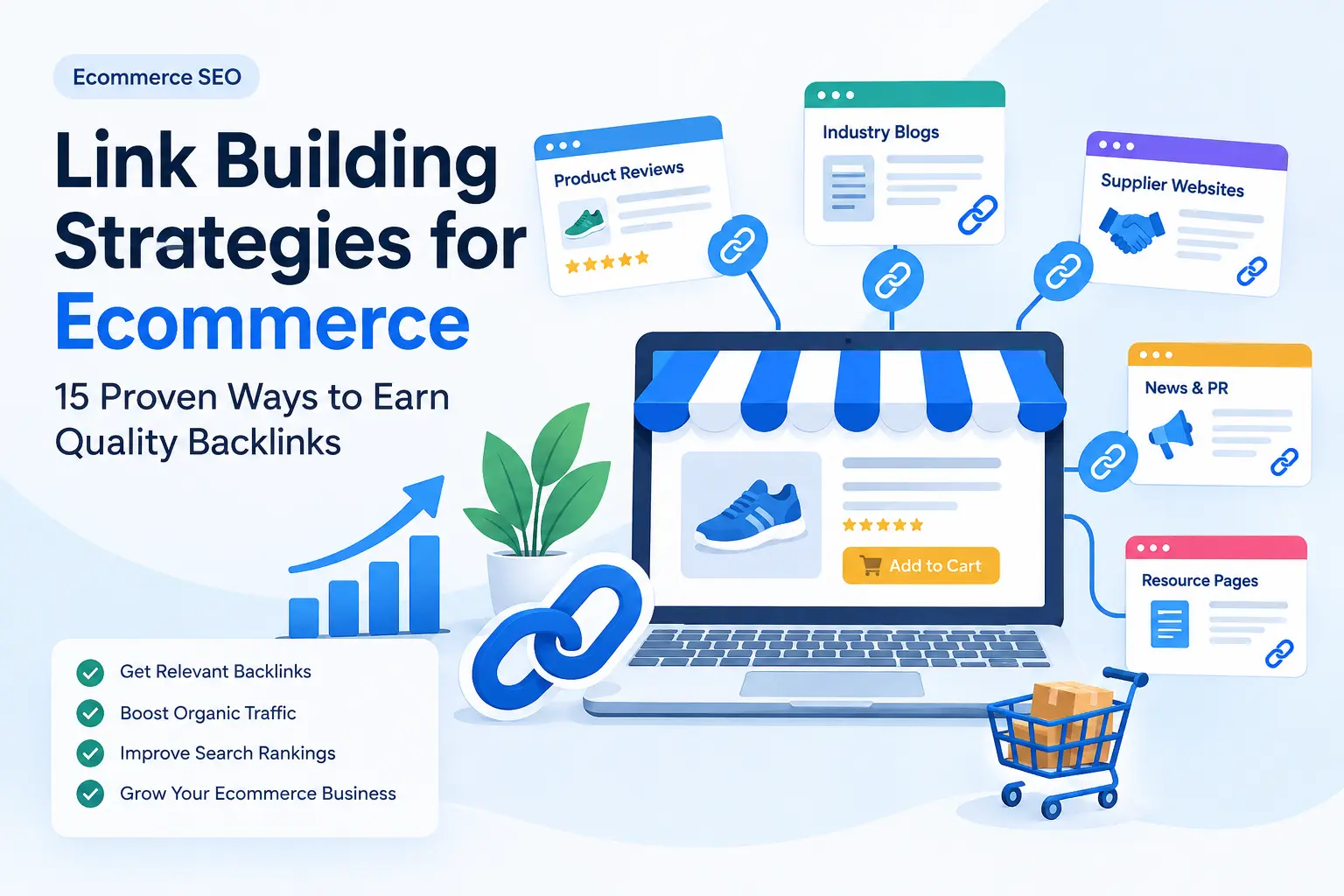
Ecommerce link building is more than acquiring backlinks to an online store. It involves earning relevant links from publishers, industry websites, manufacturers, reviewers, and other trusted sources that help shoppers discover your products and find useful information.
However, ecommerce websites face a unique challenge: the pages that generate revenue—product pages and category pages—are not always the pages that naturally attract backlinks. A detailed buying guide or original research report may be more useful to a publisher than a standard product listing.
The solution is to combine direct link acquisition with content-led outreach, genuine industry relationships, and a strong internal linking strategy. Instead of focusing solely on backlink quantity, ecommerce businesses should prioritize relevance, editorial quality, referral traffic, and the commercial value of the pages they want to promote.
In this guide, you'll learn 15 ecommerce link building strategies, how to identify worthwhile backlink opportunities, how to promote product and category pages, and how to measure the results of your efforts.
What Is Ecommerce Link Building?
Ecommerce link building is the process of earning backlinks from external websites to an online store's product pages, category pages, brand pages, and supporting content.
A backlink is a hyperlink from one website to another. When a relevant publisher references your buying guide, a manufacturer lists your store as an authorized retailer, or a product reviewer links to an item they have evaluated, your website gains a new external reference.
The objective is not simply to collect as many links as possible. An effective ecommerce link building strategy seeks relevant editorial references that can support discovery, bring qualified visitors, strengthen brand credibility, and contribute to organic search performance.
How Do Backlinks Help Ecommerce Websites?
Relevant backlinks can help search engines discover pages and understand how websites are connected. Google's ranking systems also use link-based signals when evaluating pages.
Backlinks can provide additional business benefits:
-
Organic search visibility: Relevant, editorially earned links can contribute to the signals search engines use to evaluate pages.
-
Referral traffic: Visitors can click links in product reviews, buying guides, and industry publications to reach your store.
-
Brand awareness: Mentions on respected websites introduce your business to potential customers.
-
Product discovery: Links to useful category pages, product guides, and individual products can help shoppers find relevant inventory.
-
Relationship building: Collaborations with publishers, suppliers, and complementary brands can create opportunities beyond SEO.
Backlinks are not a guarantee of higher rankings. Their value depends on context, quality, relevance, and the broader quality of your website.
Why Are Product and Category Pages Difficult to Promote?
Product pages are designed primarily to help customers evaluate and purchase an item. Category pages organize products into collections. Neither page type necessarily provides a publisher with a compelling reason to link to it.
Consider a store selling flame-resistant workwear. A basic product page listing fabric composition, available sizes, and price may be useful to a buyer but offer limited editorial value to an industry publication.
By contrast, a comprehensive guide to flame-resistant clothing standards, a fabric comparison chart, or an independently useful workwear sizing guide may be a more compelling resource to reference.
This creates a central challenge for ecommerce link building: how can you earn links to commercial pages while giving publishers a genuine reason to reference your website?
The answer is to use a combination of direct product outreach, linkable resources, editorial coverage, and contextual internal links.
What Is the Difference Between Link Building and Link Spam?
Legitimate link building focuses on earning links through useful content, genuine relationships, editorial relevance, and legitimate business partnerships.
Link spam involves attempts to manipulate search rankings through practices such as paid links that pass ranking credit, automated link creation, excessive reciprocal linking, or large-scale low-quality guest posting.
The distinction matters because a backlink campaign should support the business without exposing the website to unnecessary search-policy risks.
Why Link Building Matters for Ecommerce SEO
Ecommerce websites often compete for commercial queries where shoppers are comparing products, brands, specifications, and prices. Strong product information and technical SEO are essential, but they do not replace the need for external recognition and useful content.
Improving Search Visibility and Page Discovery
External links can help search engines discover URLs, particularly when those pages are linked from relevant websites. They can also contribute to Google's assessment of page importance and relationships between resources.
However, backlinks should complement—not replace—crawlable navigation, XML sitemaps, internal links, and technically sound page architecture.
Building Brand Credibility and Referral Traffic
A relevant mention in a respected industry publication can introduce your store to an audience that already cares about your products.
For example, a specialist workwear retailer mentioned in a construction safety resource may attract more qualified visitors than a link from a general website with no connection to workplace safety.
The value of a backlink should therefore be evaluated in terms of its context and potential audience, not only a third-party authority score.
Supporting Product and Category Page Visibility
Category pages frequently target broader commercial queries, while product pages target specific items, models, and attributes.
A sensible link acquisition plan identifies which pages matter commercially and then earns appropriate links to those pages where possible.
Supporting guides can also link internally to related categories and products, creating a logical path from informational content to shopping pages.
15 Link Building Strategies for Ecommerce Websites
1. Build Supplier and Manufacturer Backlinks
Supplier and manufacturer relationships can provide some of the most relevant backlink opportunities for ecommerce retailers.
Many brands maintain authorized dealer directories, stockist pages, partner directories, or retailer listings. If your store sells their products legitimately, you may qualify for inclusion.
How to implement this strategy:
-
Export your list of manufacturers and primary suppliers.
-
Visit their official websites and search for terms such as "Where to Buy," "Authorized Retailers," "Find a Dealer," or "Stockists."
-
Verify that your store meets the listing requirements.
-
Contact the appropriate partner or marketing representative.
-
Request a listing that identifies your business and links to the most relevant store page.
-
Check that the listing is accurate and remains live.
Example: A workwear retailer selling products from several flame-resistant clothing manufacturers could request inclusion in each manufacturer's authorized retailer directory.
Best pages to target: Brand pages, relevant product categories, or the homepage when the manufacturer requests a general store URL.
Do not assume every manufacturer offers a directory or that every request will be approved. The opportunity depends on the relationship and the manufacturer's policies.
2. Earn Product Review and Editorial Roundup Links
Product reviews and editorial roundups allow publishers to recommend products to readers who are actively researching a purchase.
Look for independent bloggers, specialist publications, industry websites, and reviewers whose audiences align with your inventory.
How to implement this strategy:
-
Identify publishers that regularly review products in your category.
-
Review their editorial standards, audience, and recent content.
-
Pitch products that genuinely fit their coverage.
-
Provide accurate specifications, product images, samples where appropriate, and access to relevant product information.
-
Allow reviewers to form their own opinions.
-
Monitor published coverage and record any links, mentions, and referral traffic.
Example: A retailer selling heavyweight cotton workwear could approach a publication that reviews durable clothing for tradespeople, explaining the garment's fabric weight, available sizes, and intended use.
Never require a positive review or a followed backlink in exchange for a free product. Material relationships should be disclosed, and links associated with commercial compensation should be appropriately qualified.
Best pages to target: Individual product pages, relevant brand pages, and product collections.
3. Use Digital PR to Earn Editorial Backlinks
Digital PR involves creating a legitimate news angle or useful story that journalists and publishers have a reason to cover.
Instead of sending generic requests asking for backlinks, offer something worth reporting: original data, expert commentary, an industry trend, a new initiative, or an independently verifiable finding.
How to implement this strategy:
-
Identify topics that matter to your customers and industry.
-
Find a newsworthy angle based on real data or expertise.
-
Prepare a concise press brief with sources, findings, and supporting visuals.
-
Build a list of journalists and relevant publications that cover the subject.
-
Personalize your pitch around their existing coverage.
-
Respond quickly to questions and provide supporting evidence.
Example: A workwear retailer could analyze publicly available workplace safety data and publish a carefully sourced report about trends relevant to protective clothing buyers. The report must accurately describe its methodology and avoid claiming that the data proves more than it does.
Best pages to target: Original research, reports, expert resources, and relevant brand pages.
Digital PR requires a real story. A routine product announcement is unlikely to earn substantial editorial coverage without a meaningful news angle.
4. Create Linkable Buying Guides and Educational Resources
Buying guides help customers compare products and make informed purchasing decisions. They also give other websites a resource worth citing.
A useful guide should answer questions that are not adequately addressed by a standard product description.
Examples of linkable resources:
-
Product comparison guides
-
Material and durability explainers
-
Sizing and fit guides
-
Product care and maintenance instructions
-
Buying guides for specific industries
-
Original comparison tables and downloadable checklists
How to implement this strategy:
-
Identify recurring customer questions.
-
Research the information shoppers need before purchasing.
-
Create an accurate, original guide with examples and clear explanations.
-
Add useful diagrams, photographs, comparison tables, or calculators where appropriate.
-
Link to relevant products and categories naturally.
-
Promote the resource to publishers, educators, bloggers, and industry communities that may find it useful.
Example: A clothing retailer could publish a guide comparing cotton workwear, blended fabrics, garment weight, and care requirements.
Best pages to target: Buying guides and educational content, supported by internal links to related categories and products.
Avoid creating a thin article solely to place internal product links. The resource should be valuable even to someone who is not ready to purchase.
5. Pitch Products for Seasonal Gift Guides and Product Roundups
Seasonal editorial content can create opportunities for relevant product coverage.
Publishers may prepare gift guides, back-to-school lists, holiday recommendations, summer essentials, or industry-specific buying roundups.
How to implement this strategy:
-
Identify recurring seasonal publications in your niche.
-
Research the types of products they feature.
-
Build a list of relevant products with accurate descriptions, prices, availability, and images.
-
Contact editors before their submission deadlines.
-
Explain why the product fits the guide's audience.
-
Keep product information updated if prices or inventory change.
Example: A retailer specializing in workwear could pitch durable clothing essentials for new apprentices or practical gift ideas for tradespeople.
Best pages to target: Relevant product pages, collections, and brand pages.
Plan ahead. Editorial calendars may be finalized well before the relevant holiday or shopping season, and inclusion is never guaranteed.
6. Perform Competitor Backlink Gap Analysis
Competitor backlink analysis helps identify websites that already link to businesses in your market.
The objective is to discover relevant opportunities—not to copy every link in a competitor's backlink profile.
How to implement this strategy:
-
Identify three to five genuine organic search competitors.
-
Export their referring domains using a backlink analysis tool.
-
Separate editorial links, supplier listings, product reviews, resource pages, and other link types.
-
Check which competitors' pages receive the links.
-
Evaluate whether your store has a comparable or better resource.
-
Prioritize relevant prospects and prepare personalized outreach.
Tools such as Ahrefs, Semrush, and Moz can help with this research, although their metrics and databases differ.
Example: If several competitors are mentioned in industry buying guides, investigate whether your products offer a legitimate fit for those guides.
Best pages to target: The page that most closely matches the reason for the original link, whether a product, category, guide, or brand page.
A competitor's link is not automatically a good opportunity. Exclude irrelevant sites, obvious link schemes, and placements that provide little value to your audience.
7. Use Broken Link Building Selectively
Broken link building involves finding links that point to unavailable pages and suggesting a relevant replacement.
This approach is useful when you can offer a resource that genuinely fills the same informational need.
How to implement this strategy:
-
Identify relevant websites and resource pages.
-
Check their outgoing links for dead destinations.
-
Review the original destination, using available historical information where necessary.
-
Determine whether your existing content is a suitable replacement.
-
If necessary, create a genuinely useful replacement resource.
-
Contact the site owner with the exact broken URL and a concise explanation.
Example: If an industry resource page links to an unavailable guide about selecting protective workwear, a comprehensive replacement guide from your store may be appropriate.
Best pages to target: Educational guides, resource pages, and relevant informational content.
A commercial product page is rarely a suitable substitute for an unrelated educational resource. Focus on relevance rather than trying to turn every broken link into a product backlink.
8. Reclaim Unlinked Brand Mentions
Sometimes publishers mention a business, product line, or brand without linking to its website.
These mentions can provide opportunities because the publisher has already chosen to reference the brand.
How to implement this strategy:
-
Monitor brand and product names using web alerts or mention-monitoring tools.
-
Search for relevant mentions that do not include a hyperlink.
-
Check whether the mention is accurate and whether a link would help readers.
-
Contact the author or editor politely.
-
Request a contextual link to the most relevant page if appropriate.
Example: A workwear publication names a retailer as a source for a specific clothing range but does not link to the retailer's product collection.
Best pages to target: The relevant brand page, collection, or original resource.
Not every unlinked mention needs to become a link. Prioritize genuine editorial contexts where the additional reference helps the reader.
9. Earn Links From Relevant Resource Pages
Resource pages collect useful websites, guides, tools, or organizations for a particular audience.
They may be maintained by trade associations, educational institutions, professional communities, or specialist publishers.
How to implement this strategy:
-
Search for resource pages within your industry.
-
Evaluate their audience, editorial standards, and relevance.
-
Identify a resource on your website that contributes something useful.
-
Explain specifically why it belongs on that page.
-
Follow the publisher's submission requirements.
-
Track the outcome without repeatedly sending generic requests.
Example: A retailer specializing in protective clothing might offer a technical guide to garment care or clothing terminology for an industry resource page.
Best pages to target: Guides, technical resources, tools, and educational content.
Avoid mass-submitting your website to unrelated directories. A smaller number of relevant, legitimate listings is more useful than a large collection of low-quality placements.
10. Develop Industry Partnerships and Co-Marketing Campaigns
Complementary businesses may share an audience without competing directly.
For example, a workwear retailer might collaborate with a training provider, industry publication, safety educator, or equipment supplier.
How to implement this strategy:
-
Identify businesses that serve the same customers with different products or services.
-
Find a shared topic that would benefit both audiences.
-
Develop a useful joint resource, event, interview, webinar, or research project.
-
Agree on editorial responsibilities and promotion plans.
-
Publish the resource on the most appropriate website.
-
Measure audience engagement, referral traffic, and business outcomes.
Example: A clothing retailer and a workplace training provider could jointly create an educational guide to preparing new workers for their first job in a particular trade.
Best pages to target: Joint resources, relevant product categories, and supporting educational content.
A legitimate partnership should have a real business purpose. Avoid excessive reciprocal linking or agreements whose primary purpose is to manipulate rankings.
11. Publish Original Research and Data-Driven Content
Original research can give publishers a reason to reference your website because it provides information they cannot simply obtain from a competing product page.
Depending on your business, useful research may include customer surveys, product testing, anonymized purchasing trends, or analysis of publicly available datasets.
How to implement this strategy:
-
Select a question that matters to your industry.
-
Determine which data you can obtain lawfully and reliably.
-
Document the methodology, sample size, limitations, and data sources.
-
Analyze the results without exaggerating conclusions.
-
Publish the findings with clear tables, charts, and explanations.
-
Share the research with journalists, bloggers, and industry professionals.
Example: An ecommerce retailer could survey customers about the factors they consider when choosing durable workwear, clearly identifying the survey population and limitations.
Best pages to target: Research reports, data visualizations, and supporting methodology pages.
Do not invent statistics or present a small, unrepresentative survey as a definitive industry-wide finding.
12. Collaborate With Influencers and Product Creators
Influencers, specialist creators, and reviewers can introduce products to relevant audiences through demonstrations, tutorials, comparisons, and independent reviews.
For link building, prioritize creators who publish on their own websites or contribute to publications where contextual references make sense.
How to implement this strategy:
-
Identify creators with audiences relevant to your products.
-
Review their content quality, engagement, and disclosure practices.
-
Offer a genuine collaboration or product sample where appropriate.
-
Allow honest opinions and independent editorial decisions.
-
Agree on commercial terms and disclosure requirements before publication.
-
Track resulting mentions, qualified visits, and conversions.
Example: A creator focused on durable clothing could demonstrate garment construction, fit, and care while linking to relevant product specifications.
Best pages to target: Product pages, collections, and educational resources.
Do not treat every social media mention as a backlink opportunity. Prioritize creators with websites or other appropriate publishing platforms, and qualify commercial links correctly.
13. Contribute Expert Articles to Relevant Publications
Expert contributions can help a business demonstrate knowledge while earning exposure to an established audience.
The strongest guest contributions answer a genuine question for the publication's readers rather than serving as disguised advertisements.
How to implement this strategy:
-
Identify publications that cover your industry or customer problems.
-
Read their submission guidelines and recent articles.
-
Pitch a distinct topic that fits their editorial calendar.
-
Provide original expertise, practical examples, and credible sources.
-
Include links only where the publication's policies allow them and where they help readers.
-
Promote the published contribution and build the relationship over time.
Example: A retailer with genuine expertise in clothing materials could contribute an article explaining how garment construction affects durability and care.
Best pages to target: Expert resources, relevant guides, and brand pages when appropriate.
Avoid mass-produced guest posts, private blog networks, and placements designed primarily to pass ranking credit.
14. Participate in Relevant Communities and Q&A Platforms
Industry forums, professional communities, and Q&A websites can help businesses understand customer questions and share useful information.
Community participation should be treated primarily as an audience-development and reputation-building activity, not a way to manufacture backlinks.
How to implement this strategy:
-
Identify active communities where your customers seek advice.
-
Read the rules on self-promotion and commercial links.
-
Answer relevant questions with practical, accurate information.
-
Share a guide or product resource only when it genuinely adds value.
-
Disclose your business affiliation when appropriate.
-
Track meaningful referral visits and customer questions.
Example: A workwear specialist could answer a question about garment care and link to a detailed care guide if the community permits it.
Best pages to target: Educational guides and reference resources.
Do not spam forums with promotional links or create artificial engagement. Some platforms automatically apply nofollow or other link attributes, and community links may offer more value through referral traffic than ranking signals.
15. Strengthen Internal Links From Linkable Content to Commercial Pages
Internal linking does not create new external backlinks, but it helps connect the pages that earn links with the pages that serve customers.
This is particularly important for ecommerce stores, where informational articles may attract more external references than product listings.
How to implement this strategy:
-
Identify your highest-value category and product pages.
-
Find relevant guides, comparisons, and resources on your website.
-
Add contextual links where they naturally help readers.
-
Use descriptive anchor text that accurately explains the destination.
-
Ensure important commercial pages are accessible through crawlable navigation and internal links.
-
Review internal links when products are discontinued or URLs change.
Example: A guide to choosing heavyweight cotton workwear could link to the relevant cotton clothing category and selected product pages.
Best pages to target: Priority product pages, category pages, and supporting collections.
Internal links should reflect a logical relationship between pages. Avoid adding repetitive, exact-match anchors to every paragraph.
How to Build Links to Ecommerce Product and Category Pages
A successful ecommerce link building campaign should not focus exclusively on blog posts. It should identify the commercial pages that matter and establish realistic ways to earn references to them.
Choose the Right Pages to Promote
Start by reviewing your store's product and category performance.
Consider:
-
Search demand for the page's target queries.
-
Organic impressions and clicks in Google Search Console.
-
Conversion rate and business value.
-
Product availability and inventory stability.
-
Existing internal links and referring domains.
-
Whether the page provides sufficient information to support outreach.
Prioritize pages where improvements could support meaningful business outcomes. A discontinued product or thin category page may be a poor investment until its underlying issues are resolved.
Create Linkable Content Around Commercial Pages
If a product page is difficult to promote directly, create a useful supporting resource that addresses the same audience's informational needs.
For example, a store selling hiking equipment could create a backpack sizing guide, a retailer selling kitchen products could publish a cookware comparison guide, and a workwear store could explain garment materials and care requirements.
The supporting content should serve a real purpose rather than exist only as a vehicle for internal links.
Use Contextual Internal Links
Connect educational content to relevant categories and products using descriptive, natural anchors.
For instance:
-
An educational guide about cotton fabrics can link to a cotton clothing category.
-
A sizing guide can link to products with matching size information.
-
A comparison article can link to the specific products being compared.
-
A care guide can link to relevant accessories or maintenance products.
This structure helps users navigate from research to relevant shopping options while giving search engines clearer context about the relationships between your pages.
How to Find and Evaluate Ecommerce Backlink Opportunities
Not every backlink opportunity deserves your time or budget. Evaluate each prospect based on relevance, editorial quality, audience fit, and the value of the proposed link.
Analyze Competitor Backlinks
Use a backlink analysis tool to compare your store with competitors.
Record the referring domain, linking page, destination URL, link context, and the reason the publisher linked to the competitor. Then determine whether your store can offer something genuinely useful.
A competitor backlink gap is a research lead, not a guarantee that the same publisher will link to you.
Evaluate Relevance and Editorial Quality
Consider these questions before pursuing a prospect:
-
Does the website publish content relevant to your industry or audience?
-
Is the linking page useful and maintained?
-
Does the proposed link fit naturally within the content?
-
Is there evidence of genuine editorial standards?
-
Could the placement send relevant referral traffic?
-
Are sponsorships or commercial relationships disclosed appropriately?
-
Does the opportunity depend on manipulative link exchanges or ranking-credit payments?
Third-party metrics such as Domain Rating and Domain Authority can assist with prioritization, but they are not Google ranking scores and should not be used as the sole quality criteria.
Monitor Broken Links and Unlinked Mentions
Set up a repeatable process for identifying relevant dead links, brand mentions, and newly published product coverage.
Prioritize opportunities where your existing content is a close match, then record outreach dates, responses, live URLs, and any changes to the destination page.
Ecommerce Link Building Mistakes to Avoid
Buying Links to Manipulate Rankings
Buying placements specifically to pass ranking credit can violate Google's spam policies. Legitimate advertising and sponsorships are different when properly disclosed and qualified.
Use rel="sponsored" for paid placements and affiliate links where appropriate; rel="nofollow" can also be used in accordance with Google's guidance.
Using Irrelevant Directories and Link Farms
Large numbers of unrelated directory listings do not substitute for relevant editorial references. Avoid link farms, automated link schemes, and directories that exist primarily to manipulate search rankings.
Use legitimate business, manufacturer, and industry directories where a listing serves a real audience or business purpose.
Over-Optimizing Anchor Text
Repeatedly forcing exact-match commercial keywords into backlinks can appear unnatural and may indicate manipulative link building.
Allow publishers to use anchors that fit their content. Brand names, descriptive phrases, URLs, and natural contextual references are all possible anchor types.
Do not attempt to enforce a universal backlink anchor-text percentage; there is no single ideal distribution for every website.
Ignoring Broken URLs and Discontinued Products
A backlink pointing to a deleted product page may no longer deliver visitors to the intended destination.
Review high-value inbound links when inventory changes. Where appropriate, redirect permanently discontinued URLs to a genuinely equivalent replacement or relevant category, rather than redirecting every deleted product to the homepage.
Maintain useful 404 responses when no relevant replacement exists, and update internal links to reflect current inventory.
How to Measure Ecommerce Link Building Results
A link building campaign should be evaluated through a combination of link acquisition, organic search performance, referral traffic, and business outcomes.
Track Referring Domains and Relevant Backlinks
Monitor:
-
New referring domains.
-
Links from relevant industry websites.
-
Destination pages receiving backlinks.
-
Link status and changes over time.
-
Referral traffic from newly acquired placements.
-
The context and attributes of commercial links.
A high link count does not automatically indicate success. Focus on the quality and usefulness of the links earned.
Measure Organic Traffic and Search Visibility
Use Google Search Console to monitor impressions, clicks, click-through rate, and average position for relevant queries and pages.
Compare performance over an appropriate period and consider seasonality, site changes, product availability, and other SEO activities. Avoid attributing every ranking change to a new backlink.
Connect Link Building to Conversions and Revenue
Use your analytics platform to measure referral sessions, engaged visits, product views, add-to-cart events, purchases, and revenue where tracking is available and properly configured.
A placement that produces fewer visits but attracts relevant buyers may be more commercially valuable than one that produces large volumes of unrelated traffic.
For paid campaigns, compare the full cost of prospecting, content creation, outreach, and placements with the outcomes achieved. Link acquisition can take time to influence organic performance, so evaluate results over a suitable period rather than promising a fixed return.
Ecommerce Link Building Action Plan: A Practical 30-Day Framework
The following plan provides a starting point for a small ecommerce team. The number of links earned will depend on the niche, resources, publisher response rates, and strength of the content.
Week 1: Research and Prioritization
-
Identify three to five organic search competitors.
-
Review their backlink profiles and linking pages.
-
Select priority product and category URLs.
-
Audit existing content for linkable resources.
-
Build a prospect list of suppliers, publishers, reviewers, and industry organizations.
Deliverable: A prioritized prospect list and a list of target pages.
Week 2: Prepare Linkable Assets
-
Improve one existing buying guide or create a genuinely useful resource.
-
Review priority product pages for accurate specifications and helpful content.
-
Prepare product information, original images, data, or expert commentary.
-
Create personalized outreach templates for different prospect types.
-
Verify that important URLs are accessible and internally linked.
Deliverable: At least one outreach-ready resource and a clear list of proposed link destinations.
Week 3: Begin Targeted Outreach
-
Contact relevant manufacturers and suppliers.
-
Pitch suitable products to reviewers and editorial roundups.
-
Promote useful resources to publishers who cover the topic.
-
Contact selected websites about relevant broken links or unlinked mentions.
-
Record every contact and follow-up in a simple outreach tracker.
Deliverable: A documented outreach campaign with relevant prospects and follow-up dates.
Week 4: Review and Improve
-
Check responses and follow up selectively.
-
Verify any newly published backlinks.
-
Review referral traffic and engagement.
-
Monitor organic performance for the pages being promoted.
-
Identify the tactics that produced the strongest opportunities.
-
Refine the next month's priorities.
Deliverable: A performance summary and a revised outreach plan.
Frequently Asked Questions About Ecommerce Link Building
What Is the Best Link Building Strategy for Ecommerce Websites?
There is no single best strategy for every store. Supplier listings, product reviews, digital PR, original research, buying guides, and relevant industry partnerships can all provide opportunities. Choose tactics according to your niche, target pages, available resources, and audience.
How Do I Get Backlinks to Ecommerce Product Pages?
Start with legitimate manufacturer listings, relevant product reviews, editorial roundups, and genuine product-related coverage. You can also create useful supporting content and link internally to related products. A direct product-page backlink should make sense in the publisher's context.
Are Backlinks Still Important for Ecommerce SEO?
Backlinks remain one of the signals used in search systems, but they are not the only factor that determines rankings. Product information, technical accessibility, content quality, relevance, user experience, and competition also matter.
How Can I Find Competitors' Backlinks?
Use a backlink analysis tool such as Ahrefs, Semrush, or Moz to review referring domains and linking pages. Identify the reason each competitor earned a link, then assess whether your store has a relevant resource or relationship that could create a legitimate opportunity.
Should Ecommerce Websites Buy Backlinks?
Buying links specifically to manipulate search rankings creates policy risk. Businesses can purchase advertising or sponsored placements for legitimate marketing purposes, but those links should be appropriately qualified. Prioritize editorially earned links and useful business relationships rather than ranking-credit schemes.
How Many Backlinks Does an Ecommerce Website Need?
There is no universal backlink target. Requirements vary by niche, search competition, target page, and the strength of competing websites. Evaluate the quality and relevance of your backlink profile alongside organic visibility and business performance.
How Long Does Ecommerce Link Building Take to Show Results?
There is no guaranteed timeline. Outreach responses may arrive quickly, while earning editorial coverage and observing organic search changes can take considerably longer. Track link acquisition and business outcomes over time instead of relying on a fixed ranking guarantee.
Which Tools Help With Ecommerce Link Building?
Google Search Console helps monitor organic search performance. Backlink analysis tools such as Ahrefs, Semrush, and Moz can help identify referring domains and competitor opportunities. Web analytics tools can measure referral visits and conversions. Choose tools according to your workflow and budget rather than assuming a paid subscription is required for every tactic.
Conclusion: Build Relevant Backlinks That Support Ecommerce Growth
The most sustainable ecommerce link building strategies focus on earning useful references rather than collecting links indiscriminately. Supplier relationships, editorial product coverage, digital PR, original research, buying guides, and targeted outreach can help stores develop a more relevant backlink profile.
Start by identifying the product and category pages that matter most to your business. Find the publishers and organizations that genuinely serve your audience, create resources worth referencing, and use internal links to connect that content with your commercial pages.
Measure the results through link quality, organic visibility, referral traffic, and conversions. By consistently improving the relevance and usefulness of your content and outreach, you can build a link acquisition process that supports your broader ecommerce SEO strategy.
Want us to help grow your business?
Xright Solutions helps Kentucky businesses rank higher, get more traffic, and turn visitors into customers.
Book a Free Consultation →